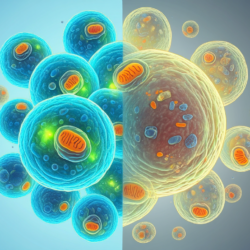
Cell senescence is a biological process whereby a cell permanently stops dividing while remaining metabolically active. This mechanism plays an essential role in protecting the body: it limits the proliferation of damaged cells, participates in tissue repair and helps preserve tissue integrity in the face of biological attacks.
Long approached mainly from the perspective of cellular ageing, senescence is now considered a central phenomenon in modern biology. It actually has two sides: a protective side, useful in the short term, and a deleterious side when senescent cells accumulate in tissues. To learn more about this concept, please see our article on the accumulation of senescent cells with age.
What is cellular senescence?
Under normal conditions, cells divide to ensure tissue renewal.
However, when a cell undergoes significant alterations, it can activate a safety programme that permanently blocks its multiplication. This biological response prevents a potentially dangerous cell from spreading.
The senescent cell remains alive, but it adopts a particular behaviour. It modifies its metabolic activity and secretes various signalling molecules grouped under the term SASP (Senescence-Associated Secretory Phenotype). This secretory profile can help coordinate local repair, but it can also maintain inflammation when it becomes chronic.
In other words, senescence is not simply a passive shutdown. It is an active, organised and highly regulated biological programme.
Why do cells enter senescence?
Several factors can cause a cell to enter senescence. These signals generally correspond to situations in which continuing cell division would become risky for the organism.
- Telomere shortening: as cells divide, telomeres shorten and eventually trigger a halt in the cell cycle.
- DNA damage: radiation, toxins or replication errors can alter genetic material.
- Oxidative stress:excess free radicals damage membranes, proteins and DNA.
- Chronic inflammation: persistent inflammatory signals promote senescence.
- Metabolic disorders: hyperglycaemia, mitochondrial dysfunction or energy imbalances can accelerate this process.
These different stresses activate cellular surveillance pathways involving proteins such as p53, p21 and p16, which permanently slow down cell division.
Why is senescence useful to the body?
Cellular senescence fulfils several protective functions. In particular, it prevents the proliferation of cells that have suffered significant genetic damage, which helps to limit the risk of tumour transformation.
It also plays a role in tissue repair. In certain situations, senescent cells release signals that attract immune cells and facilitate the elimination of damaged cells. This transitional phase can therefore contribute to tissue healing and remodelling.
During embryonic development, senescence also appears to be involved in the fine structuring of certain organs. This observation shows that it is a fundamental biological programme, useful in several contexts of life.
When does senescence become problematic?
The problem is not senescence itself, but its abnormal persistence. In a young, functional organism, senescent cells are generally eliminated after fulfilling their mission. When this cleansing process becomes less effective, they accumulate in tissues and alter their environment.
This accumulation promotes a chronic low-grade inflammatory state called inflammaging. The tissues then become less flexible, less reparative and more vulnerable to age-related dysfunctions.
We detail this mechanism in our article dedicated to the persistence of senescent cells over time.
Can we influence the mechanisms involved in cellular senescence?
Cellular senescence depends on many biological parameters, some of which are influenced by the environment and lifestyle. Without claiming to “block” senescence, it is possible to support the mechanisms that limit excessive inflammation, oxidative stress and metabolic disorders.
Several levers can be integrated into a comprehensive approach:
- a diet rich in protective nutrients and antioxidants
- a lifestyle that promotes biological resilience and cell regeneration
- regular physical activity
- restorative sleep
- prevention of metabolic imbalances
In pharmacies, our patients often tell us that as they age, they recover less quickly after an inflammatory episode, an infection or prolonged fatigue. This observation in the field clearly illustrates the idea that tissue resilience evolves over time and also depends on the overall condition.
| Biological factor | Main effect | Potential consequence |
|---|---|---|
| Oxidative stress | Cell damage | Increased senescence |
| Chronic inflammation | Persistent activation of SASP | Accumulation of senescent cells |
| Telomere shortening | Cell cycle arrest | Cellular ageing |
| Metabolic dysregulation | Energy and mitochondrial stress | Impaired regeneration |
For a broader perspective, this first article is part of our series on cellular ageing, which also includes a section on the accumulation of senescent cells, another on the role of diet, and a final section on lifestyle, hormesis and longevity.
Frequently asked questions about cellular senescence
Is cellular senescence normal?
Yes. Senescence is a normal biological mechanism that protects the body by preventing damaged cells from dividing.
Does cellular senescence cause ageing?
It contributes to ageing when senescent cells accumulate in tissues. Conversely, when it is transient, it plays a protective role.
What is the difference between senescence and apoptosis?
Senescence corresponds to a definitive halt in cell division while the cell remains alive, whereas apoptosis corresponds to programmed cell death.
Why do senescent cells become problematic with age?
Because they are less easily eliminated by the body. Their accumulation maintains chronic inflammation and can slow down tissue repair.
Can we influence the factors linked to cellular senescence?
Yes. A healthy lifestyle, including a balanced diet, physical activity, quality sleep and metabolic prevention, can support the biological mechanisms involved in cellular health.
Written and medically validated by Arnaud, Doctor of Pharmacy and owner of Pharmacie Soin et Nature.