Osteoarthritis is a chronic joint condition that severely impacts the daily lives of millions of people. Faced with nagging pain, stiffness and a loss of independence, the search for an effective and long-term solution is therefore a top priority. Whilst conventional medicine offers emergency relief during acute flare-ups, many patients turn to complementary therapies to develop a long-term treatment plan. Among these, herbal medicine stands out as a preferred option. Thanks to powerful, targeted active ingredients, medicinal plants can have a profound effect on the body. Discover how to design a bespoke herbal approach.
How is herbal medicine revolutionising the treatment of osteoarthritis?
To provide lasting relief for a worn joint, it is not enough to simply mask the pain from time to time. A comprehensive and effective osteoarthritis treatment must therefore address the condition from several biological angles. This is precisely the strength of phytotherapy, which is based on three complementary areas of action:
- The remineralising approach: This provides the minerals and trace elements essential for strengthening bone structure, stimulating collagen synthesis and supporting the cartilage matrix.
- The anti-inflammatory approach: This aims to quell the inflammatory flare-ups in the synovial membrane that perpetuate the destruction of joint tissue and consequently trigger painful episodes.
- The detoxifying or anti-toxic approach: This promotes the elimination of metabolic waste and acids that accumulate in the body and exacerbate local inflammation.
Which are the best plants to include in your osteoarthritis treatment?
Here are detailed fact sheets on the most effective plants to include in your care routine, classified according to their main therapeutic properties.
Remineralising plants to strengthen cartilage
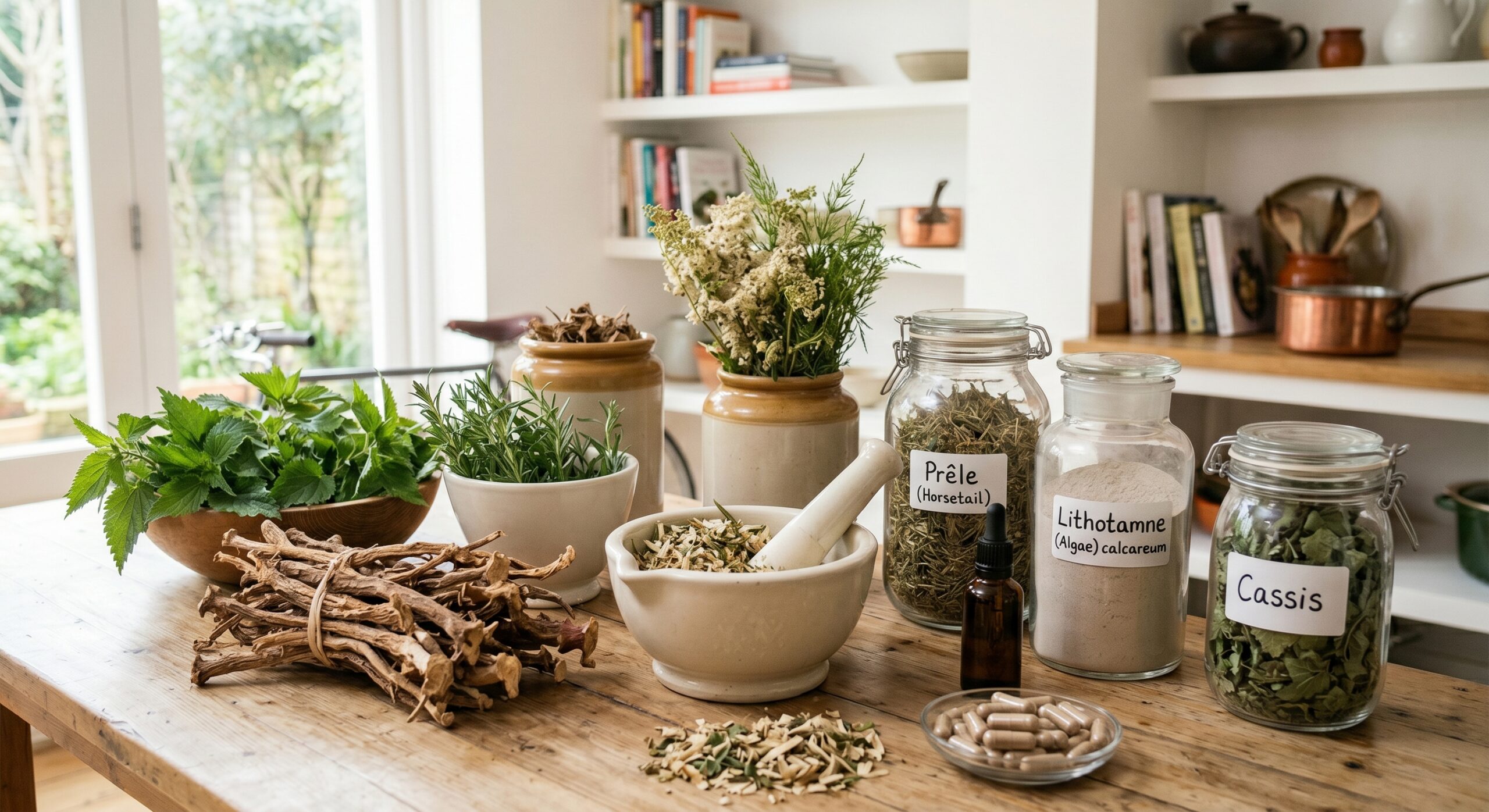
- Horsetail: Thanks to its exceptional natural silica content (5–10% of the dry plant), it plays a major role in collagen synthesis and the maintenance of connective tissue. It also promotes the metabolic absorption of calcium.
- Dosage: 2 x 400 mg capsules in the morning, or as a prolonged decoction of the dried aerial parts. Take as a 20-day course once a month (maximum effect with a 3-month course).
- Contraindications: Use with caution in cases of severe heart or kidney problems.
- Lithothamnion: This calcareous seaweed is a veritable treasure trove of marine minerals, particularly absorbable calcium (25–30%), magnesium and iron. Highly alkalising, it neutralises excess acidity produced by the body.
- Dosage: Take approximately 3 g per day. It is often combined with horsetail, which is recommended for a synergistic effect.
- Contraindications: Due to its naturally high iodine content, this seaweed is strictly not recommended in cases of hyperthyroidism.
- Bamboo: The sap from the bamboo stem contains between 60 and 70% natural silica. As silicon is a key component of connective tissue, it plays an active role in bone formation and thus helps to slow down cartilage degeneration.
- Dosage: As a dry extract (capsules), taken in regular 3-month courses for optimal joint comfort.
- Contraindications: Adhere to the recommended doses; not recommended during pregnancy as a precautionary measure.
Anti-inflammatory herbs to relieve pain
- Harpagophytum (Devil’s Claw): Rich in iridoids (harpagoside and procumbide), this root is one of the most powerful natural painkillers. It is the cornerstone of herbal treatment for osteoarthritis.
- Dosage: Available as capsules or standardised extracts. Courses of treatment should last for at least 3 weeks (long-term use over several months is possible).
- Contraindications: Contraindicated during pregnancy, breastfeeding and in cases of peptic ulcer. Do not combine with non-steroidal anti-inflammatory drugs (NSAIDs).
- Meadowsweet: It contains salicin, a salicylic derivative and natural precursor of aspirin. It is therefore particularly effective in relieving rheumatism aggravated by damp, cold weather.
- Dosage: As an infusion (50 g of flowering tops per litre of water, steep for 10 minutes) or 1 teaspoon of fluid extract per day for long-term relief.
- Contraindications: Contraindicated in cases of duodenal ulcer, aspirin allergy, and in pregnant or breastfeeding women.
- White Willow: Its bark offers anti-inflammatory and analgesic effects similar to meadowsweet, thanks to its high content of salicylic derivatives, thus helping to relieve mechanical pain.
- Dosage: Decoction of 20 to 30 g of bark per litre of water. Drink 2 to 3 cups a day before meals.
- Contraindications: Same restrictions as for aspirin (ulcers, bleeding disorders, pregnancy).
- Blackcurrant: Blackcurrant leaves are rich in flavonoids and vitamins C and P. They combine a powerful anti-inflammatory effect with a diuretic action that eliminates uric acid and toxins from the body.
- Dosage: Infusion of 50 g of leaves per litre of water (3 cups a day between meals) or 2 capfuls of SIPF Blackcurrant a day diluted in a glass of water.
- Contraindications: Use with caution in cases of severe heart or kidney failure requiring fluid restriction.
- Figwort: It contains active ingredients identical to those found in harpagophytum. It is ideal for alleviating chronic pain and stiffness.
- Dosage: Decoction of 15 to 20 g of root per litre of water for 10 minutes; drink 2 cups a day.
- Contraindications: Not recommended during pregnancy, while breastfeeding, for children, or in cases of heart failure. Contraindicated when taken in combination with warfarin.
- Boswellia Serrata: Its resin contains boswellic acids that block the synthesis of inflammatory molecules. Clinical studies demonstrate its effectiveness in reducing pain and thus improving flexibility (particularly in the knee).
- Dosage: 150 to 200 mg three times daily of an extract containing at least 60% boswellic acids. Allow 4 to 8 weeks to fully experience the effects.
- Contraindications: Not recommended during pregnancy.
The whole plant: both remineralising and anti-inflammatory
- Stinging nettle: Its leaves are a real Swiss Army knife. Rich in calcium and organic silica, they nourish the joints whilst blocking the inflammatory cascade (inhibition of prostaglandins and cytokines).
- Dosage: Infusion of 30 to 60 g of leaves per litre of boiling water (steep for 10 minutes). Drink one cup 2 to 3 times a day before meals, or take in capsule form.
- Contraindications: Caution is advised if taken alongside diuretic treatments.
The benefits of these plants are enhanced when combined with a healthy lifestyle. To maximise your results, discover our advice on an anti-inflammatory diet and a lifestyle to combat osteoarthritis.
Furthermore, if you wish to combine the power of herbal medicine with a fine-tuning of your body’s balance, do also explore our guide to homeopathy and osteoarthritis.
Building an effective herbal treatment for osteoarthritis is therefore a worthwhile strategy for anyone wishing to protect their body without suffering from serious side effects. Whether it’s nourishing the matrix of your joints with silica (horsetail, bamboo), relieving painful flare-ups (harpagophytum, meadowsweet, boswellia) or even purifying tissues (blackcurrant, nettle), nature provides us with highly effective active ingredients. To achieve lasting results, always combine this treatment with a healthy lifestyle and do not hesitate to seek advice from your healthcare practitioner to tailor the dosages to your individual needs.
Sources:
- HAL Open Science:Plants and the management of joint and muscle pain
- Science Direct: Turmeric & Boswellia Serrata on the reduction of knee osteoarthritis pain
- Vidal: traditional use of Harpagophytum.
FAQ – Osteoarthritis and herbal treatment: your frequently asked questions
Can Harpagophytum be used as a long-term treatment for osteoarthritis?
Yes, Harpagophytum is perfectly suited to chronic conditions and can therefore be taken over several months. However, as this is a maintenance treatment, it is advisable to take therapeutic breaks (for example, 3-week courses followed by a one-week break) to avoid saturating the body’s receptors and to check whether symptoms persist.
Why is it beneficial to combine horsetail and lithothamnion?
The combination of these two plants is ideal for remineralisation. Lithothamnion provides a rich blend of minerals (particularly calcium) and reduces the body’s overall acidity, whilst horsetail supplies the silica needed to bind this calcium and stimulate collagen production within the cartilage.
Does meadowsweet pose the same stomach risks as conventional aspirin?
Although meadowsweet contains salicin (a precursor of aspirin), its plant-based form is holistic and combined with protective tannins. It is generally much better tolerated by the stomach lining than synthetic chemical aspirin. Nevertheless, as a precautionary measure, it remains contraindicated in cases of severe gastric ulcer or a known allergy to salicylates.
How long does it take to assess the effectiveness of herbs on the joints?
Phytotherapy is a form of practical medicine that requires regularity. Whilst it is possible to feel initial relief from inflammation after 3 weeks with herbs such as harpagophytum or boswellia, it is strongly recommended that you continue the treatment for 3 to 4 months before making a definitive judgement on the overall effectiveness of the treatment on your mobility.