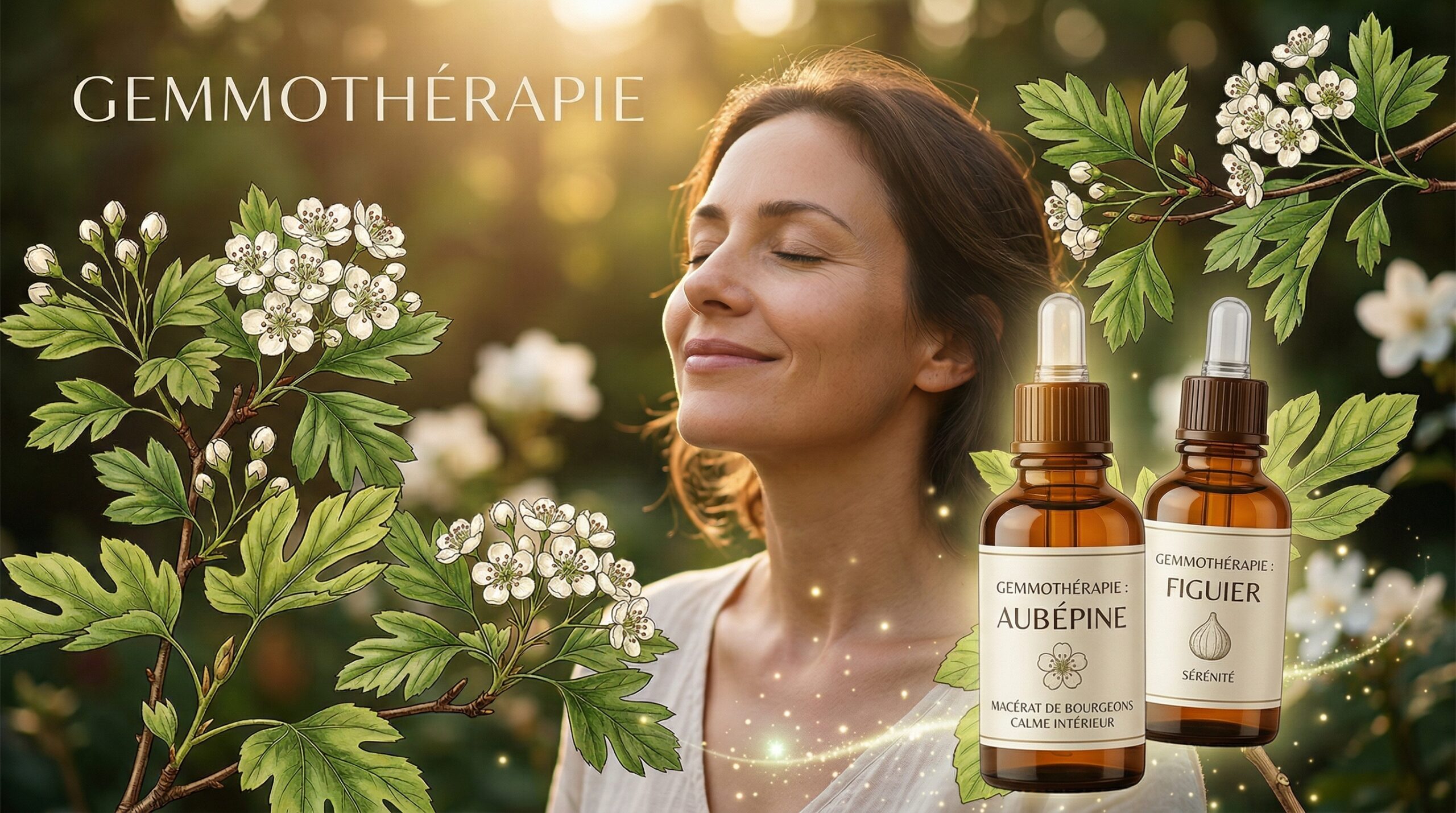
Gemmotherapy and anxiety are a combination increasingly explored by those seeking natural solutions to relieve anxiety attacks. This branch of herbal medicine uses plant buds and young shoots – that is, actively growing tissue rich in minerals, vitamins, plant hormones and developmental ‘information’. They are often regarded as veritable ‘concentrates of information’, capable of gently supporting the body’s key regulatory systems: the nervous system, the heart, digestion and stress adaptation. Indeed, gemmotherapy for stress is being studied for its effects on emotional well-being.
Unlike herbal teas or extracts from mature plants used to treat anxiety, glycerine macerates of buds act in a more holistic and gradual manner. They are particularly beneficial for anxiety-prone individuals, especially when significant physical symptoms are present: palpitations, chest tightness, a knot in the stomach, gastritis or stress-related digestive disorders. Used correctly, they can help restore balance, as a complement to conventional herbal medicine, nutritional therapy or essential oils. Consequently, many experts highlight the potential of gemmotherapy specifically targeting stress during periods of anxiety.
Hawthorn bud: how does it affect the heart and emotions?
Among the major gemmotherapy remedies for anxiety, hawthorn bud (Crataegus oxyacantha) holds a prominent place. As a bud macerate, hawthorn acts on both the cardiovascular and nervous systems: it regulates the heart rate, promotes the relaxation of blood vessels and helps reduce nervousness and stress-related sleep disorders.
It is particularly recommended when anxiety manifests as cardiac somatisation: palpitations, functional tachycardia, a feeling of chest tightness, or a heart that ‘races’ at the slightest stress. Many people also describe a sensation of a ‘fragile heart’ or cardiac fear, even though medical tests remain reassuring: in such cases, hawthorn bud extract can provide valuable support.
The usual dosage for adults is between 50 and 100 drops per day, taken in 2 or 3 doses, in a little water, between meals, depending on the type of macerate (1DH or mother macerate, according to the manufacturer’s and healthcare professional’s recommendations). Treatment usually begins with a lower dose, which is then gradually increased if well tolerated. Courses of treatment often last a few weeks (for example, 3 weeks on, 1 week off), with regular reassessment, particularly in cases of concomitant cardiovascular treatment.
Fig Bud: why is it beneficial for anxiety and digestion?
Fig tree bud (Ficus carica) is the other mainstay of gemmotherapy for anxiety. It is considered a fundamental remedy for the digestive system and the psychological sphere: calming and nerve-balancing. Indeed, the fig tree is particularly suited to situations of stress, anxiety, mild nervous breakdowns and associated digestive disorders.
In practice, it is recommended for anxiety accompanied by rumination and a ‘knot in the stomach’, as well as gastritis or heartburn linked to the somatisation of anxiety. It works via a central mechanism: by modulating certain nerve centres involved in gastric acid secretion and digestive motility, it helps to soothe both the mind and the digestive tract. This is why it is often cited as a remedy of choice for people who ‘struggle to process their emotions’. Consequently, the use of gemmotherapy for stress is appropriate for alleviating these conditions.
In standard practice, Ficus carica Buds MG 1DH is used at a dosage of 50 to 100 drops per day for an adult, divided into 2 or 3 doses, as with hawthorn. Some authors suggest more frequent dosing (for example, 5 to 10 drops, 2 to 3 times a day), but the principle remains the same: start low, increase if necessary, and always adjust according to the individual’s constitution and any other treatments being taken. Courses of treatment last a few weeks, with breaks, and may be repeated during certain high-risk periods (times of overwork, seasonal changes, anxiety-inducing events).
How can bud extracts be integrated into a comprehensive strategy for managing anxiety?
Bud therapy for anxiety often yields better results when integrated into a holistic strategy rather than used on its own. In practical terms, one can:
- Combine hawthorn bud (for the cardio-emotional aspect) and fig bud (for the anxiety–digestion axis), sometimes starting with a single bud and then moving on to a complex if tolerance is good. Many manufacturers also offer fig and hawthorn combinations (with lime blossom, for example) specifically targeted at stress and anxiety. Note that ‘stress gemmotherapy’ can be adapted to individual needs.
- Supplement with conventional herbal medicine (passionflower, lemon balm, valerian, etc.) to support sleep and muscle relaxation, or with nutritional therapy (magnesium, omega-3) to improve the neuro-emotional state.
- If necessary, add carefully selected essential oils (true lavender, petitgrain bigarade, Roman chamomile), applied topically or via inhalation, to cope with occasional peaks of anxiety or stress.
In terms of duration, treatments generally last 3 to 6 weeks, with daily intake followed by a break and a reassessment. Gemmotherapy remains a gentle approach, but one based on genuine active extracts. However, caution is advised in cases of pregnancy, breastfeeding, heart conditions or long-term medication, and you should seek advice from a trained healthcare professional.
Conclusion
Gemmotherapy and anxiety make an interesting combination when seeking targeted support for the heart (hawthorn bud) and the anxiety–digestion axis (fig tree bud). These macerates fit perfectly into a holistic approach that combines a healthy lifestyle to combat stress, herbal medicine, nutritional therapy and aromatherapy. To explore this further, you can refer to the articles on anti-stress medicinal plants and essential oils for anxiety, to build a coherent and safe natural toolkit. In short, gemmotherapy for stress can form an integral part of a holistic approach to wellbeing.
FAQ – Gemmotherapy and anxiety
Is gemmotherapy sufficient to treat anxiety?
No. Hawthorn or fig tree buds can help with mild to moderate anxiety, but they are no substitute for medical advice or potential psychotherapeutic support in cases of significant anxiety disorders.
How should hawthorn and fig buds be taken for anxiety?
For adults, the usual dose is 50 to 100 drops per day of glycerine macerate (1DH or mother macerate depending on the product), taken in 2 or 3 doses, in a little water, over a few weeks, followed by a break.
Can hawthorn and fig be combined in the same course of treatment?
Yes, this is actually a classic combination: hawthorn mainly targets cardiac somatisation (palpitations, tightness in the chest), whilst fig acts more on anxiety, rumination and stress-related digestive disorders.
Are there any contraindications to gemmotherapy for anxiety?
Caution is advised in cases of pregnancy, breastfeeding, cardiovascular conditions or long-term treatments (cardiac, psychotropic, etc.). In these situations, it is best to seek advice from your doctor or pharmacist before starting a course of treatment.