Homeopathy is a complementary therapeutic approach based on personalised care. It is not a substitute for standard dermatological treatments for severe or infectious acne. Always seek advice from a doctor or pharmacist before making any changes to your treatment.
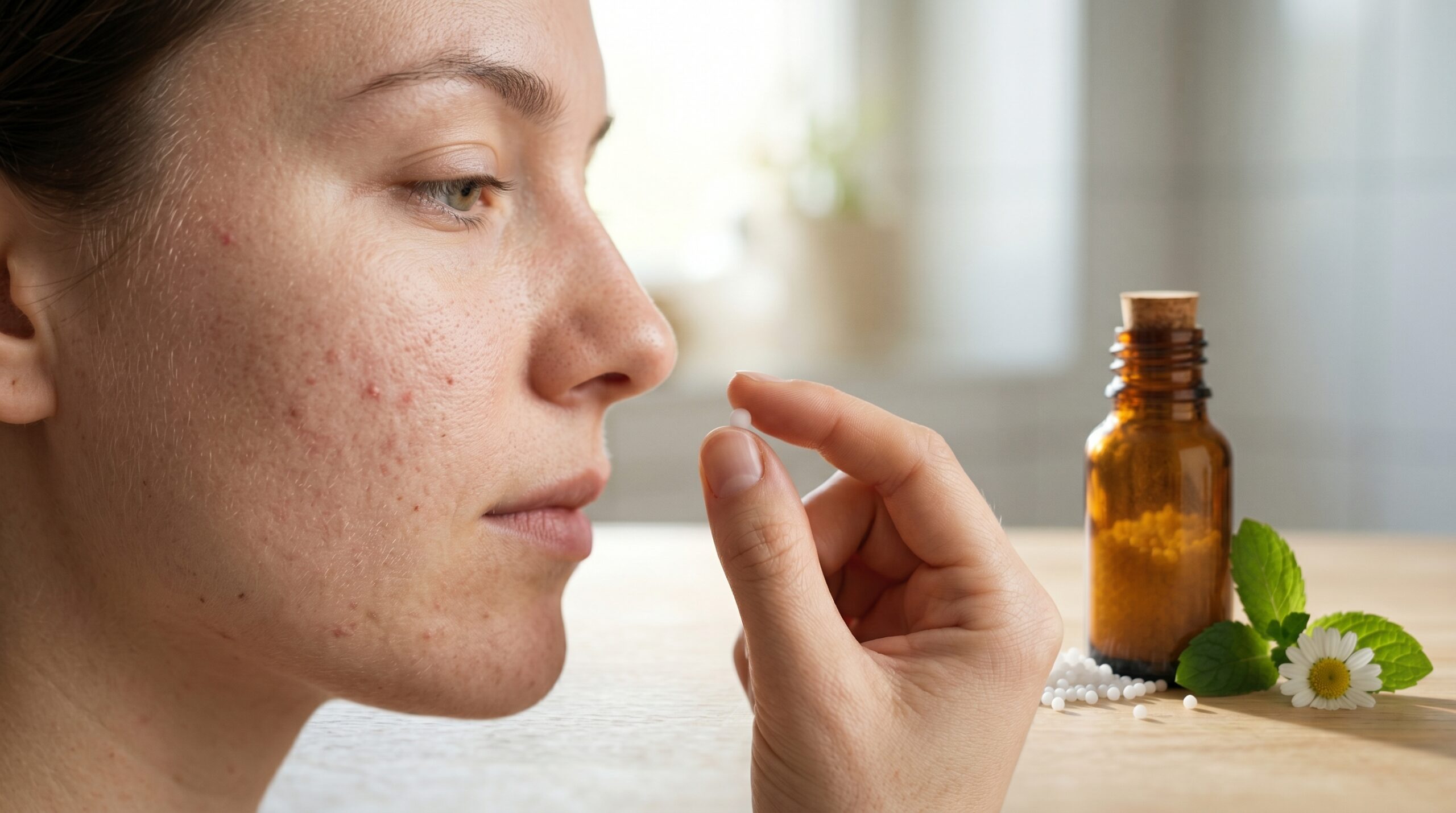
When it comes to skin blemishes,conventional treatments can sometimes be harsh or come with uncomfortable side effects such as severe dryness. This is why many people turn to homeopathy for acne, a gentle approach that seeks to treat the problem not just at the surface. Indeed, it works by rebalancing the body’s overall constitution. However, starting a homeopathic treatment for acne cannot be done on a whim. As this is a highly personalised method, the key to success lies in the careful selection of homeopathic remedies for acne. These must be tailored to your biological and psychological profile. Discover how this approach targets each type of lesion, thereby helping to deeply purify your skin.
Why is it essential to consult a doctor before starting homeopathic treatment for acne?
It is difficult to make generalisations about homeopathic granules, as this method focuses primarily on the patient and the root cause of the condition rather than just the visible symptom. Dr Philippe Louis, a homeopathic dermatologist, explains the specific nature of this approach:
“Like any doctor, the homeopath will examine your skin to determine the type of acne you are suffering from. This examination will, however, be supplemented by a questionnaire designed to better understand your personality, your lifestyle and your current state of mind. Homeopathy is a form of medicine that considers the patient as a whole. Attention will therefore be paid to both the patient’s physical and psychological aspects.”
Consequently, the prescription will vary according
to
your individual characteristics (sensitivity to stress, diet, reaction to the climate). Furthermore, finding the right balance requires perseverance. Dr Louis points out that it sometimes takes a while to stabilise the patient’s condition. Thus, if the first homeopathic prescription is not immediately perfect, the specialist will need to test several active ingredients, one by one, over a period of six weeks. You must therefore persevere. Furthermore, you must not give up too quickly. Indeed, once the right remedy is found, the therapeutic effect is excellent.
Which homeopathic remedy should be used for juvenile acne and excess sebum?
Juvenile acne in homeopathy, as well as so-called ‘uncomplicated’ forms, generally respond very well to remedies targeting seborrhoea. Furthermore, these remedies also target everyday triggers. Depending on the specific symptoms of oily skin, several profiles can be distinguished:
- Selenium 7 CH: This is the go-to remedy for oily, shiny skin (severe seborrhoea). The skin has an oily appearance, is dotted with blackheads, and the breakouts consistently worsen after sun exposure. It is often recommended if the acne is accompanied by general fatigue or hair loss.
- Sulfur iodatum 7 CH: Particularly suitable for teenagers who feel the cold easily and catch colds frequently, when breakouts are mainly concentrated on the forehead and back (3 granules 3 times a day).
- Eugenia jambosa 4 to 5 CH: This remedy is mainly used for young girls with oily skin and hardened pustules, whose lesions worsen significantly during their period (three doses a day).
- Juglans regia 4 to 5 CH: Recommended when outbreaks are clearly worsened by the consumption of fatty foods. In young girls, this profile is sometimes accompanied by early, dark-coloured periods, or frequent intestinal bloating.
- Antimonium crudum 4 to 7 CH: Preferred for ‘heavy eaters’ or when the breakout follows obvious overeating.
How can homeopathy treat suppurating acne and inflammatory spots?
When spots become red, hot, painful and filled with pus, the main objective changes. It is necessary to curb the bacterial infection, limit the pain and accelerate the cleansing of the tissues. Furthermore,homeopathy for inflammatory acne relies on very specific remedies:
- Arnica montana 7 CH: Widely recognised for its anti-inflammatory, analgesic and healing properties. In the case of suppurative flare-ups, it reduces skin inflammation, relieves local pain and promotes better blood circulation to nourish and cleanse the skin from within. It is also ideal (in 5 CH) when lesions are symmetrical, prone to bruising, or when the patient has a bad habit of picking at them.
- Hepar sulfur: This remedy is used when acne is highly inflammatory and the pus is bloody or foul-smelling. Caution: its use is delicate and requires medical approval. Used in low dilutions, it promotes suppuration to help the spot mature; in high dilutions, it produces the opposite effect by drying out the lesions.
- Silicea 4 to 15 CH: Often recommended for slender individuals who are sensitive to the cold. In low dilutions (two doses a day), it promotes skin healing, prevents secondary bacterial infections and helps to remineralise the body.
- Sulfur 9 CH: Highly effective if the patient’s general symptoms match the profile, but its prescription in its pure form is strictly reserved for the doctor, as there is a real risk of a temporary worsening of the spots. Sulfur iodatum 9 CH is often preferred, as it is much easier to use.
Which homeopathic remedies target scarring acne and microcysts?
The healing of a spot sometimes leaves behind stubborn marks: hard cysts lodged beneath the skin or indented or raised scars. To reduce these after-effects and soften the skin tissue, the homeopathic approach offers fundamental solutions:
- Antimonium tartaricum 4 CH: Taking 5 granules daily actively helps the body repair damaged tissue and helps prevent the formation of acne scars (a mechanism similar to that used to minimise chickenpox marks).
- Baryta carbonica 4 to 7 CH: When scars are already established and hardened, and the skin appears hardened, atrophied or locally retracted.
- Kalium bromatum 9 CH: This remedy specifically targets hardened, deep and painful cysts. Its prescription is often associated with general nervous symptoms, particularly constant fidgeting of the hands.
- Tuberculinum residuum 9 CH: Used when scarred lesions remain hard to the touch and are frequently accompanied by small palpable lymph nodes, particularly if acne is widespread on the back.
- Luesinum 9 CH: A remedy for severe cases, recommended only when skin lesions are extremely extensive, destructive to tissue and show a clear tendency to ulcerate.
Homeopathy for acne is not simply a matter of replacing an antibiotic cream with sugar granules. It is a holistic approach to natural health that requires observing one’s body, understanding its reactions and accepting the time needed for biological regulation. By addressing the root cause rather than stripping the skin, it offers an alternative. Furthermore, it provides valuable support for conventional treatments. To ensure a comprehensive treatment plan, consulting a professional remains your best course of action.
Need immediate local relief whilst waiting for your long-term treatment to take effect? Read our article on Essential oils and natural remedies for acne.
Is your diet undermining your efforts? Find out by reading our Comprehensive Guide: Diet and Acne.
Scientific sources and medical references:
- Dr Philippe Louis – Interviews and clinical observations in homeopathic dermatology.
- University of Lorraine – Management of benign skin conditions in the pharmacy using homeopathy
- Vidal / Homeopathy for the Family – Using homeopathy effectively
FAQ – Your frequently asked questions about homeopathy and acne
How long does it take to see the effects of homeopathy on spots?
Homeopathy works at a deep level, so results are not immediate. It usually takes between 4 and 6 weeks. This corresponds to a full skin renewal cycle plus a period for the body to adapt. This timeframe allows the effectiveness of a remedy to be assessed. However, if no change is observed after two months, the treatment should be reviewed by your practitioner.
Can homeopathy cause a flare-up of spots at the start of treatment?
Yes, this phenomenon of temporary worsening is possible, particularly with potent remedies such as Sulphur 9 CH or Hepar sulphur in low dilutions. This is a sign that the body is reacting and expelling toxins. However, if this flare-up lasts more than a few days or proves too painful, stop taking the remedy. In this case, seek advice from your doctor or pharmacist.
Can homeopathy be used alongside antibiotics or creams prescribed by a dermatologist?
Absolutely. Homeopathy does not cause any adverse drug interactions with conventional treatments. On the contrary, certain remedies (such as Natrum muriaticum 9 CH) are regularly recommended to alleviate the side effects of conventional treatments. For example, they can reduce the extreme dryness of the skin caused by certain medications.