
What exactly is a ‘cortisol detox’?
Since 2024, cortisol has occupied a special place in online wellness discourse. It is presented as the cause of weight gain and a puffy face. It is also blamed for chronic fatigue, waking up during the night, and sometimes burnout. The proposed solution is always the same: you need to ‘detox’ it, ‘cleanse’ it or ‘reset’ it.
The protocols vary. The promises, however, remain constant: a transformation in thirty days, a flat tummy and a boost in energy. These include cold baths and cutting out caffeine. They also include ‘adrenal cocktails’, playlists of sound frequencies and numerous supplements marketed on this basis.
The problem isn’t that these routines are all pointless. Some have genuine benefits, such as improving sleep or practising slow breathing. The problem lies in the explanation associated with them. This explanation is based on a false understanding of how the hormone works.
Can cortisol really be ‘detoxed’?
A hormone produced continuously, never stored
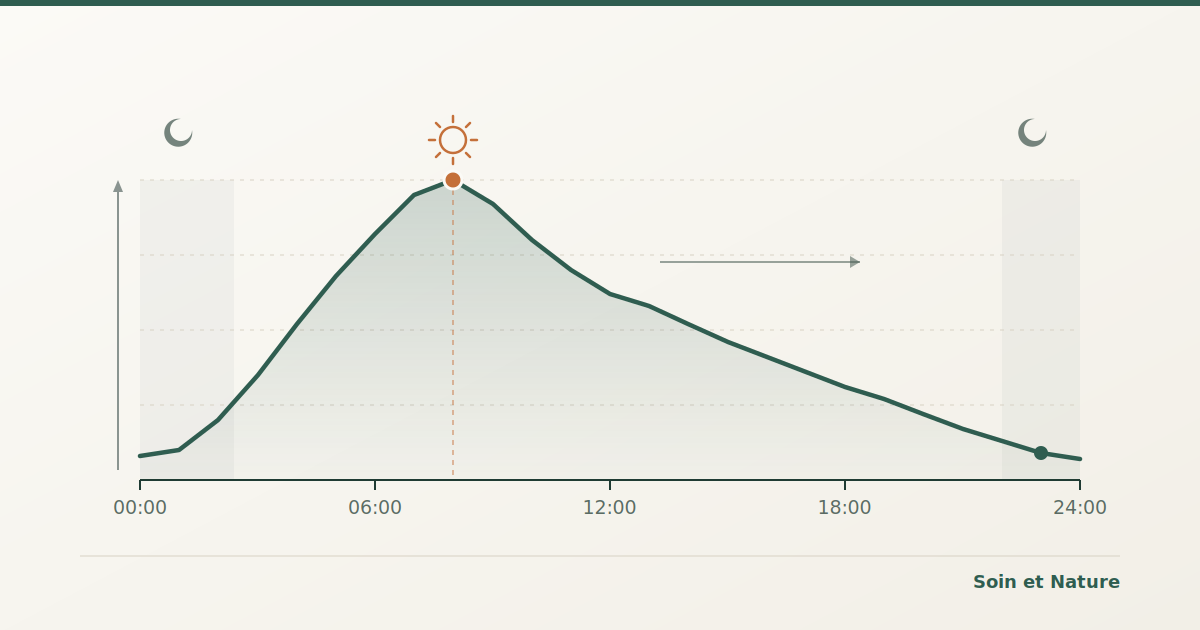
The adrenal glands produce cortisol. The hypothalamic-pituitary-adrenal axis regulates this production. A biological clock, the suprachiasmatic nucleus, regulates its rhythm. As Inserm points out, secretion peaks in the morning, which helps us wake up. It then decreases throughout the day, reaching a low point at the start of the night.
This hormone is essential for life. It helps regulate blood sugar levels, blood pressure and the immune response. It also helps keep us awake. A person who does not produce enough of it develops adrenal insufficiency. This is a serious condition requiring lifelong treatment.
The concept of ‘detox’ implies the accumulation of a foreign substance, such as a heavy metal. Cortisol does not work in this way. The body produces it and then constantly breaks it down, with a half-life of around one hour. There is no reservoir to be emptied.
What really goes out of balance: the rhythm, not the quantity
The amplitude of the rhythm, however, can indeed become disrupted. Under chronic stress, the literature describes a flattening of the curve throughout the day. It does not describe a permanent elevation.
The problem is therefore not an excessively high total quantity. It is a signal that loses its sharpness between morning and evening. On this point, Inserm is explicit. Unless you have an endocrine disorder diagnosed by a doctor, there is no justification for trying to regulate your cortisol levels.
Confusion with a rare condition
These two expressions originated on social media. They refer to a rounded face or a bulging stomach, attributed to excess cortisol. They derive their credibility from a very real condition: Cushing’s syndrome. The neurosurgeon Harvey Cushing described it in the early 20th century. It is characterised by a rounded face, central weight gain, muscle wasting in the limbs and purple stretch marks.
But the scale is completely different. According to the Orphanet encyclopaedia, this syndrome affects approximately one person per million per year, excluding forms linked to corticosteroids. The cortisol levels observed in this condition far exceed those associated with ordinary stress. The duration of exposure is also incomparable.
A puffy face on waking is not a hormonal sign
A face that appears puffy in the morning is most often due to temporary water retention. A lack of sleep, salt or alcohol consumed the night before are sufficient to explain it. Facial contours also change naturally with age. Attributing these changes to a hormone, without testing, remains mere conjecture.
The issue goes beyond scientific accuracy. The concerns addressed by this content relate to highly codified aesthetic criteria: the stomach, the cheeks, the jawline. Turning an ideal of appearance into a hormonal problem lends medical credibility to body dissatisfaction. It also points to an internal culprit. The mechanism is guilt-inducing, even whilst presenting itself as benevolent.
Does ‘adrenal fatigue’ exist?
The theory claims that chronic stress depletes the adrenal glands. These would eventually fail to produce enough cortisol. An American chiropractor first put forward this idea in 1998. It is applied to rather non-specific symptoms: tiredness upon waking, cravings for salt or sugar, difficulty recovering, and low mood.
A systematic review from 2016, published in BMC Endocrine Disorders, examined 3,470 articles. It selected 58 of them. Its conclusion leaves no room for doubt: there is no evidence to support adrenal fatigue as a genuine condition. The authors highlight contradictory results and unvalidated testing methods. They also point to causal conclusions that the data do not support.
This confusion is not trivial. There is, in fact, a genuine condition characterised by insufficient cortisol production:adrenal insufficiency. Addison’s disease is the best-known form of this condition. It is diagnosed via a blood test and is treatable. Left untreated, it can be life-threatening. An online questionnaire that concludes a person has ‘adrenal fatigue’ may therefore delay a proper diagnosis.
| Common claim | What physiology tells us | Status |
|---|---|---|
| ‘You need to detox your cortisol’ | The body continuously produces and breaks down cortisol; it does not store it | Unfounded |
| “High cortisol levels are caused by stress” | A symptom of Cushing’s syndrome, affecting approximately 1 in a million people per year | Confusion with a rare condition |
| “You are suffering from adrenal fatigue” | No endocrinology society recognises this condition | Not recognised |
| “This supplement lowers cortisol” | No claims regarding cortisol are authorised in Europe | Unauthorised claim |
| “Chronic stress causes cortisol levels to skyrocket” | The literature actually describes a flattening of the daily rhythm | Excessive simplification |
Cortisol and perimenopause: what do the studies actually show?
This is the area where online discourse diverges most from the evidence. Everywhere you look, it is claimed that falling oestrogen levels cause cortisol levels to skyrocket. This, in turn, is said to explain hot flushes, waking up at night and weight gain around the waist. The reality is far less straightforward.
What the Seattle Midlife Women’s Health Study shows
This study was published in the journal *Menopause* in 2006. It monitored the urinary cortisol levels of women going through the menopausal transition on a monthly basis. It did indeed observe a rise around the onset of the late transition phase. However, the authors make a crucial distinction: cortisol levels rise with age, with no established link to the stages of the menopausal transition. The extent to which this rise is specifically due to the menopause therefore remains unclear.
A finding that contradicts the prevailing view
A second study is worth noting. Published in *Menopause* in 2020, it followed 101 perimenopausal women aged between 45 and 55. Over a twelve-week period, the researchers measured the frequency and severity of hot flushes. At the same time, they monitored salivary cortisol levels.
The result is surprising. Women with the most frequent and severe symptoms showed a smaller, rather than a larger, increase in morning cortisol levels. Among those with the most symptoms, the response therefore appears blunted rather than heightened.
This finding does not establish a causal link. The study is observational, as its authors emphasise. However, it directly contradicts the prevailing view that perimenopausal symptoms reflect excess cortisol.
The practical conclusion is a relief. If you are going through a difficult perimenopause, it is not because you have mismanaged your stress. Your symptoms have a physiological explanation that places no blame on you.
Should you have your cortisol levels tested?
Cortisol can be measured in the blood, saliva or a 24-hour urine sample. Each method is subject to strict sampling conditions, particularly regarding timing. The expected value at 8 am bears no relation to that at midnight. Outside this framework, a result is meaningless.
The French Society of Endocrinology restricts screening for Cushing’s syndrome to specific situations. It cites fat accumulation in the face and trunk associated with specific clinical signs. It also cites conditions that are unusual for a person’s age, such as high blood pressure before the age of 40. The incidental discovery of an adrenal mass also warrants such screening. However, it does not recommend it for people with diabetes, high blood pressure or who are overweight but asymptomatic: the condition remains too rare in these cases.
In pharmacies, we see people coming in with the results of saliva tests they have ordered themselves online. These tests are carried out without any medical indication and are then interpreted by an automated questionnaire. More often than not, they do not allow any conclusions to be drawn. Above all, they create unfounded anxiety. More seriously, they sometimes wrongly reassure someone whose fatigue warrants a proper medical assessment.
What should you do if you feel constantly under pressure?
None of the above means your fatigue is imaginary. Waking up during the night and feeling under pressure are very real experiences. They deserve to be taken seriously. What is wrong is the idea that targeting a hormone is the solution.
A meta-analysis of randomised trials evaluated stress management interventions. It found an average effect on cortisol levels. Mindfulness and relaxation stand out as the most effective approaches. However, there is a significant caveat to this finding: the effect does not persist at follow-up. Regular practice therefore seems necessary. Consistency matters more than intensity.
Details of specific strategies are set out in another article. Sleep, physical activity, breathing, and the potential role of magnesium and adaptogenic plants: all these are discussed in our article on the link between cortisol and weight gain after the age of 40.
Would you like personalised support tailored to your situation? Soin et Nature’s Naturo Service is available to answer your questions free of charge via our contact page.
When should you consult a doctor or your pharmacist?
This article does not encourage you to ignore your fatigue. It simply serves as a reminder that self-diagnosing hormonal issues based on online content is not the right approach. It may even delay the identification of the actual cause.
Signs that warrant a medical consultation:
- Rapid weight gain around the stomach, without any change in diet, accompanied by thinning arms and legs.
- Wide, purplish stretch marks; skin becoming more fragile; frequent bruising.
- Muscle weakness in the thighs, difficulty standing up from a chair.
- New-onset high blood pressure, particularly before the age of 40.
- Intense and persistent fatigue, or mood or sleep disturbances that become established.
- Unexplained menstrual cycle irregularities.
Precautions before self-medicating:
- No supplement has an authorised claim regarding the reduction of cortisol. Be wary of any product that suggests this.
- Adaptogenic herbs are not recommended during pregnancy or whilst breastfeeding. Exercise particular caution if you have a thyroid or autoimmune condition.
- Ask your pharmacist for advice before combining a supplement with any current treatment. Interactions are possible.
Your pharmacist remains your first point of contact. They can check for interactions, put test results into context, and refer you to your doctor when the situation requires it.
Sources
- Inserm — Is it really necessary to ‘regulate your cortisol’? (Canal Détox, March 2026)
- Orphanet / French Society of Endocrinology — Cushing’s syndrome — Orphanet General Public Encyclopaedia
- Cadegiani F.A., Kater C.E. — Adrenal fatigue does not exist: a systematic review, BMC Endocrine Disorders, 2016
- Woods N.F. et al. — Increased urinary cortisol levels during the menopausal transition, Menopause, 2006
- Sauer T. et al. — Perimenopausal vasomotor symptoms and the cortisol awakening response, Menopause, 2020
- Rogerson O. et al. — Effectiveness of stress management interventions to change cortisol levels: a systematic review and meta-analysis, Psychoneuroendocrinology, 2024
- European Commission — Regulation (EU) No 432/2012: list of authorised health claims
Institutional and scientific sources consulted in August 2026. This article is for information purposes only. It is not a substitute for personalised medical advice.
Frequently asked questions about cortisol detox
Does a cortisol detox really work?
There is no such thing as a cortisol detox in the physiological sense. The body does not store this hormone: it produces it and then continuously breaks it down. Some routines marketed under this name do offer genuine benefits, such as improving sleep or practising slow breathing. It is the explanation that is incorrect, not always the practice itself.
How do you know if you have too much cortisol?
There are no outward signs to indicate this. Only a blood test prescribed by a doctor, carried out at a specific time of day, can assess this. Online questionnaires claim to identify high cortisol levels based on common symptoms. They have no diagnostic value.
Is the ‘cortisol face’ a genuine medical condition?
No, it is not a medical term. It derives its credibility from the rounded face associated with Cushing’s syndrome. This rare condition affects around one person per million per year, excluding forms linked to corticosteroids. A puffy face upon waking is far more often caused by sleep, salt or alcohol.
Does the menopause cause cortisol levels to rise?
The evidence remains mixed. Studies describe a rise during the late menopausal transition. However, the authors point out that cortisol levels also rise with age, and the extent to which this is specifically due to the menopause has not been established. A 2020 study even observed a lower morning response in women with the most severe hot flushes.
When should you consult a doctor or pharmacist about cortisol?
Seek advice promptly if you experience rapid weight gain around the abdomen, wide, purplish stretch marks, weakness in the thighs or recent high blood pressure. Severe and persistent fatigue is also a reason to seek advice. Before taking a supplement marketed as an ‘anti-cortisol’ product, seek advice from your pharmacist, especially if you are currently on any medication.