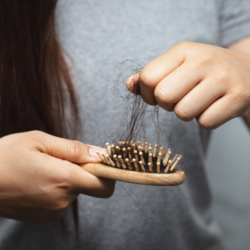

Why do we lose our hair in autumn?
Each hair goes through three phases. First, a growth phase, which lasts three to seven years in women. This is followed by a short transitional phase. Finally, there is a resting phase, at the end of which the hair falls out and makes way for the next one.
Normally, each follicle progresses at its own pace. Hair loss therefore goes unnoticed. However, summer disrupts this gentle rhythm: heat, sun, a disrupted daily routine, and sometimes a diet before the holidays. As a result, a larger number of hairs enter the resting phase at the same time.
However, this resting phase itself lasts two to three months before the hair falls out. In other words, what you see in the shower in September actually happened back in June. It is precisely this time lag that makes autumn hair loss so baffling: nothing has changed in your daily life, and yet your hair is falling out.
How many hairs do we lose per day without it being abnormal?
Obviously, nobody counts their hairs. In practice, the figure serves mainly as a guide: it serves as a reminder that visible daily hair loss is not in itself abnormal.
Three indicators are better than a count. Firstly, the thickness of your ponytail: if the hair tie needs to be wrapped round one more time than before, the density has genuinely decreased. Secondly, the width of your parting, which you should compare in two photos taken a month apart. Thirdly, the distribution: seasonal hair loss is diffuse; it doesn’t cause thinning in any particular area.
In the chemist’s, we often see people coming in with a photo of their shower drain. However, this photo doesn’t tell us much, as it shows the build-up from several days of washing. Comparing two photos of the parting, on the other hand, is much more revealing.
How long does seasonal hair loss last?
The good news can be summed up in one sentence: this type of hair loss resolves itself. The follicle isn’t destroyed; it has simply gone into a resting phase along with its neighbours. It then resumes growth as normal.
The sign that regrowth has begun is, in fact, easy to spot. Look at your hairline and temples against the light: small, short, fine hairs standing upright are a sign that regrowth has started. Many people mistake these for broken hairs, when in fact they are new ones.
On the other hand, hair loss that persists for more than three months is no longer a seasonal phenomenon. It then warrants further investigation.
When should hair loss really be a cause for concern?
| What you notice | What this suggests | What to do |
|---|---|---|
| Diffuse hair loss, lasting less than three months, following the summer | Likely to be a seasonal fall | Monitor and photograph the patch |
| Diffuse hair loss that has lasted for more than three months | It is no longer the season | Consult a doctor, blood tests |
| Receding hairline, thinning at the crown | Androgenetic alopecia | Dermatological consultation |
| Distinct patches, smooth scalp | Alopecia areata | Seek medical advice without delay |
| Fatigue, sensitivity to the cold and sluggish bowel movements | Possible thyroid issue | TSH test |
| Heavy periods, pallor, shortness of breath on exertion | Iron deficiency | Ferritin test |
| Itching, scabs, scalp pain | Scalp condition | Seek medical advice |
What tests should be carried out if hair loss persists?
The VIDAL lists iron deficiency, thyroid disorders, the postnatal period and restrictive diets amongst the most common causes of diffuse hair loss. These four conditions have one thing in common: they can be confirmed by a test, not by guesswork.
Two tests are the first port of call. Ferritin reflects iron stores, and its levels drop well before haemoglobin does: it is therefore possible to be iron-deficient without being anaemic. TSH, on the other hand, assesses thyroid function. We explain this test and how to interpret the results in detail in our article on the symptoms that warrant a thyroid check-up.
However, one important precaution must be taken. Never take iron supplements without first having a blood test. The body does not eliminate excess iron, and unnecessary supplementation is not without risk. The test results are the deciding factor, followed by the doctor’s advice.
Seasonal hair loss or androgenetic alopecia: how can you tell the difference?
This distinction makes all the difference, because the two conditions do not require the same timeframe or the same solutions. Confusing one with the other wastes months.
| Seasonal hair loss | Androgenetic alopecia | |
|---|---|---|
| Distribution | Diffuse, across the entire scalp | Localised: parting, crown, temples |
| Onset | Sudden, within a few weeks | Slow, over several years |
| Progression | Spontaneously reversible | Progressive without treatment |
| Appearance of the hair | Unchanged | Thinner, shorter hair |
| Management | Monitoring, correction of any deficiency | Dermatological assessment, specific treatment |
What benefits can hair supplements offer, and how long does it take?
Only three claims are authorised at European level in this area. Zinc and selenium help maintain normal hair and nails. Biotin, on the other hand, helps maintain normal hair and skin, but not nails: this distinction often comes as a surprise, yet it is very much the case.
The word ‘maintenance’ is worth pausing over. These nutrients support normal functioning; they do not restart a process that has come to a standstill. Consequently, a course of treatment makes sense when intakes are insufficient or requirements are increased. It serves no purpose in addressing a cause that has not been identified.
Then there is the question of time, and this is the most disappointing aspect. A hair grows by about one centimetre per month. Nothing will therefore be visible for two to three months. A course of treatment should be assessed after three months, not three weeks.
In pharmacies, it is premature discontinuation that we see most often. People return after three weeks saying ‘it’s not working’ — precisely at the point when no results are yet visible.
To support you through these vulnerable periods, you can browse our selection of dietary supplements for hair and nails. Arnaud is happy to recommend Phytalessence Hair & Nails as a simple maintenance formula to be taken over a three- or four-month course.
For natural everyday approaches, including simple routines and plants, see also our article on how to prevent hair loss naturally.
What precautions should you take before starting a course of treatment?
This first precaution is not widely known, yet it is extremely important here. High doses of biotin interfere with many blood tests carried out using immunoassays. Thyroid hormones are among these, as is troponin, a cardiac marker.
The result may therefore be falsely high or falsely low, with no obvious indication of this. Imagine the situation: you are taking a hair treatment, you have your TSH tested because your hair is falling out, and the result is unreliable. This is why you must inform the laboratory about the treatment and stop taking biotin a few days before the blood test, as advised by your doctor or pharmacist.
Two further points are worth bearing in mind. If you are pregnant or breastfeeding, always seek advice before starting any treatment. Finally, avoid taking several supplements at the same time: if an adverse effect occurs, there is no way of knowing which one is to blame.
Frequently asked questions about autumn hair loss
How much hair do we normally lose each day?
Between 50 and 100 hairs a day, according to VIDAL. This is a natural part of the hair renewal cycle. Hair loss becomes significant if more than 100 hairs are lost daily, or if it is concentrated in one area of the scalp.
Why does hair loss mainly occur in autumn?
Because a greater number of hairs enter the resting phase during the summer. This phase then lasts two to three months before the hair falls out. The hair loss observed in September therefore corresponds to the process that began in June.
How long does seasonal hair loss last?
Four to eight weeks, generally. Regrowth is then complete within three to four months. Hair loss that lasts for more than three months is no longer seasonal and warrants medical advice.
Can hair loss be caused by the thyroid?
Yes, thyroid disorders are among the documented causes of diffuse hair loss. This becomes a serious possibility when other symptoms are present: persistent tiredness, sensitivity to the cold, and sluggish bowel movements. A TSH test can then provide a definitive diagnosis.
When should you consult a doctor or pharmacist about hair loss?
Seek advice if the hair loss has lasted for more than three months, if it is thinning in a specific area, or if your scalp becomes painful. Do not wait if distinct patches of baldness appear, or if other symptoms accompany the hair loss. Your pharmacist can carry out an initial assessment and advise you.
Sources
- VIDAL — Hair loss and alopecia: hair cycle, normal daily hair loss, telogen effluvium, causes and regrowth time.
- Regulation (EU) No 432/2012 establishing the list of authorised health claims — zinc, selenium, biotin.
- ANSM — Information sheet on biotin’s interference with immunoassay tests.
This article is for information purposes only. It is not a substitute for medical advice. If you experience persistent or unusual hair loss, speak to your doctor or pharmacist.